Voice, Intelligence, and the Home: Eleven Years In
By Alex Capecelatro, Co-Founder & CEO of Josh.ai
Josh.ai was founded with the vision to make the home more intuitive, more intelligent, and more delightful through the power of voice. What began as an ambitious idea at the intersection of AI, privacy, and luxury living has evolved into a platform trusted by homeowners, integrators, and design professionals around the world. As we reflect on eleven years of innovation, this milestone offers an opportunity to look beyond the technology itself and examine how voice intelligence is reshaping our relationship with the spaces we inhabit. The home is no longer simply connected, it is becoming contextually aware, deeply personalized, and capable of anticipating our needs in ways that once felt firmly rooted in science fiction.
Josh Micro - September 2018
When we founded Josh.ai, the idea of speaking naturally to your home and having it respond with precision and intelligence was still largely aspirational. Voice interfaces existed, but they were constrained, brittle, and rarely designed for the complexity of the residential environment. Most systems at the time relied on rigid command grammars, limited vocabularies, and interaction models that felt more like programming than conversation.
We approached the problem from first principles. Language, if it could be understood with enough fidelity, is the most natural interface humans have. But bringing that into the home required more than advances in speech recognition. It required building a system that could operate reliably in a dynamic, noisy, highly contextual environment where ambiguity is the rule rather than the exception.

Very early on, we recognized that voice in the home is a full-stack problem. At the hardware layer, we developed purpose-built devices like Josh Micro and Josh Nano, designed specifically for far-field voice interaction. These systems incorporate beamforming microphone arrays with advanced digital signal processing pipelines, including acoustic echo cancellation, noise suppression, and low-latency wake word detection models trained for always-on listening. The objective was not proximity-based interaction, but ambient interaction, where a user could speak naturally from across the room and be understood without friction.
Josh Nano - November 2020
Capturing clean audio, however, is only the first stage in a much deeper pipeline. Once speech is converted into a probabilistic text representation, the central challenge becomes intent resolution. In a home, even simple phrases carry significant ambiguity. The command, “turn on the lights,” requires resolving which lights, in which room, under what context. Is the user referring to a lighting load, a predefined scene, or a contextual default based on time of day? Even numerical instructions such as, “set the volume to twenty percent," must be disambiguated from phonetically similar interpretations like, “two hundred twenty percent,” requiring reconciliation between speech recognition outputs and domain constraints.
To address this, we built an internal knowledge graph that models the home as a structured set of interconnected entities: devices, rooms, media services, entertainment sources, and user preferences. This graph enables probabilistic intent ranking, allowing the system to evaluate multiple interpretations and select the most likely one based on context, state, and historical interaction patterns. When a user says “turn on ,” the system dynamically determines whether is best interpreted as a device, a room, a scene, or a piece of media content.

Natural language also introduces temporal dependencies. Users frequently rely on anaphora, issuing follow-up commands such as,“turn it off” or “turn it up,”* expecting the system to maintain conversational context. Supporting this requires maintaining a rolling context window, tracking active entities and recent interactions, and resolving references in a way that feels intuitive rather than mechanical. Without this layer, voice systems quickly devolve into rigid interfaces that require unnatural specificity.
We extended this further with compound command parsing, which remains one of the more technically demanding aspects of voice interaction. A request like, “turn off the TV, listen to jazz, and lock the front door” must be decomposed into discrete intents while preserving syntactic structure, semantic boundaries, and execution order. Each clause may map to a different subsystem, from AV control to media discovery to security. Parsing and executing these correctly requires a combination of linguistic segmentation, domain-specific validation, and orchestration across distributed systems, particularly when dealing with ambiguous or unconventional media names.
From there, we began exploring how voice could move beyond control into configuration. This led to what we call natural language programming, where users can describe desired behaviors and have the system compile those descriptions into executable automations. Instead of constructing rules manually, a user can articulate intent in plain language, and the system translates that into a structured representation of triggers, conditions, and actions.
Natural Language Programming Scenes - October 2022
What is happening beneath the surface is a form of constrained semantic parsing, mapping open-ended language into deterministic logic that can be executed reliably over time. The challenge lies in balancing expressive flexibility with operational precision, ensuring that the resulting automation behaves consistently even as the input language varies.
For much of the past decade, systems like these were built on deterministic architectures augmented by machine learning at key stages. The emergence of large language models introduced a fundamentally new capability: open-ended reasoning over language. With the integration of these models through JoshGPT, the scope of interaction expanded beyond control into knowledge and recommendation.

Users could now ask questions that are not explicitly tied to the state of the home, such as,“what are some good shows my family might enjoy that take place in Paris,” and receive contextual responses. More importantly, we began connecting these reasoning capabilities back into the control layer. A request like, “set the lights to the colors of my favorite sports team,” requires resolving external knowledge, mapping that knowledge to device capabilities, and executing a coordinated result within the home. Similarly, “play the song at the end of The Breakfast Club” involves identifying the correct track through knowledge retrieval and initiating playback through integrated media systems.
Josh AI Scene Creation - 2026
This convergence of probabilistic reasoning and deterministic control introduces both opportunity and complexity. Large language models operate on probability distributions and are not inherently deterministic. They can produce outputs that are plausible but incorrect, or interpret instructions in ways that are technically valid but contextually misaligned. In domains where the cost of error is low, this is acceptable. In the home, where actions can affect safety, security, and comfort, it is not.
At the same time, user expectations have shifted. People increasingly expect to interact with their environment as fluidly as they interact with conversational AI. Bridging that expectation with the need for reliability is one of the central challenges we are focused on today. Many approaches in the market prioritize demonstration over robustness, connecting language models directly to device control in ways that perform well in controlled scenarios but lack the safeguards required for real-world deployment.
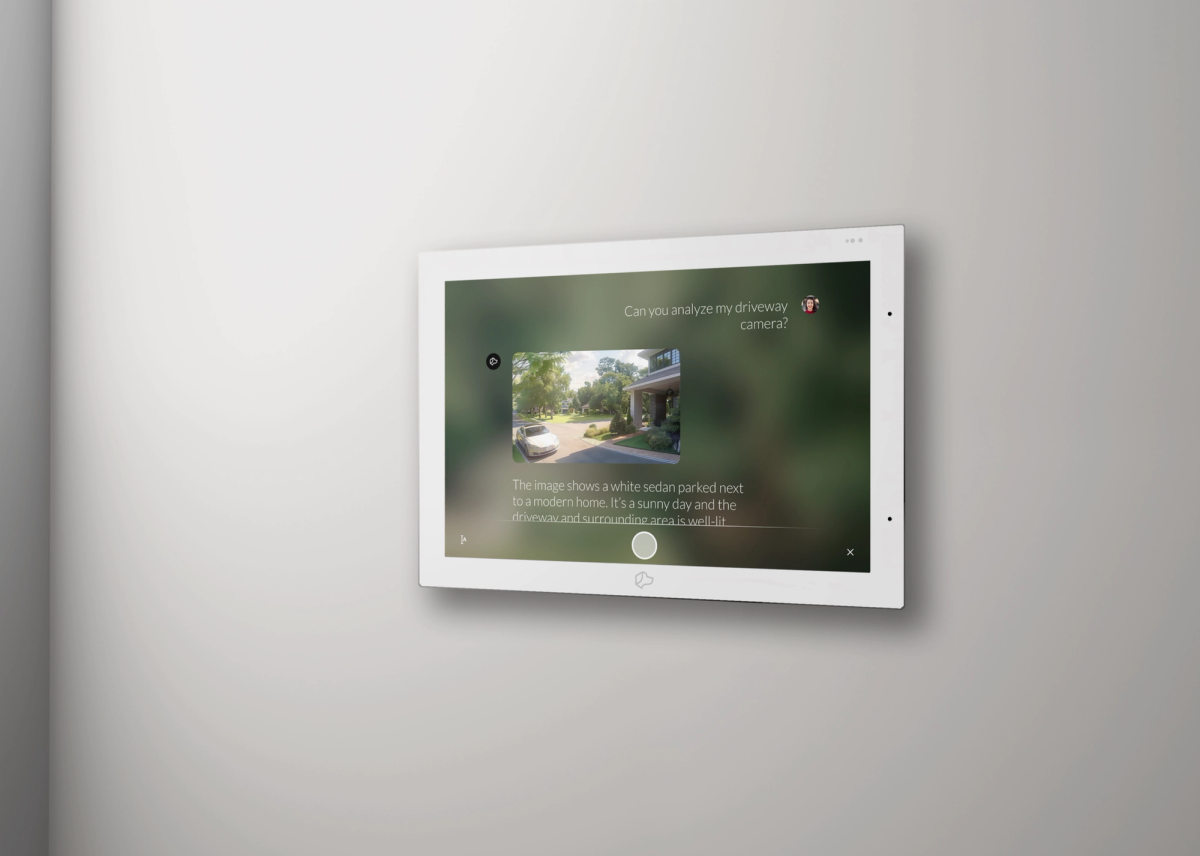
Our approach has been to treat this as a hybrid systems problem. The future of voice in the home will not be purely rules-based, nor purely driven by large language models. It will be an integrated architecture that combines deterministic control systems with probabilistic reasoning engines, mediated by a rich, real-time understanding of context. This includes spatial awareness, user identity, device state, and temporal factors, all of which inform how a request should be interpreted and executed.
Hardware continues to evolve alongside software in this model. With Josh Edge, we introduced a portable interface that integrates voice input, local context awareness, and programmable physical controls. The device leverages room-level context to infer intent and allows users to dynamically assign functionality through voice, effectively turning natural language into a configuration interface for hardware itself.
Josh Edge Programming Buttons with AI - 2026
What this points toward is a broader shift in interface design. Control surfaces are no longer static artifacts defined at installation. They become adaptive, user-defined, and continuously reconfigurable through interaction.
Looking ahead, it is clear that voice itself is not the endpoint. The focus is shifting toward intelligence, toward systems that can integrate multiple modalities, reason about intent with greater depth, and operate with a level of reliability that supports everyday use. Achieving this requires advances not only in AI models, but in how those models are embedded within larger systems that prioritize determinism, safety, and performance.

Over the past eleven years, we have moved from early experiments in far-field voice capture to building a platform that integrates natural language understanding, contextual reasoning, and real-world control. The work has required solving problems across acoustics, signal processing, machine learning, and distributed systems architecture. It has also required a willingness to tackle the less visible challenges, the edge cases, failure modes, and integration complexities that ultimately define whether a system can be trusted.
In closing, I want to end with a thought that has guided much of our work:
“The ultimate goal of AI in the home isn’t to make you speak more precisely. It’s to make the home understand you more completely. When technology reaches that point, it stops feeling like technology at all. It becomes something closer to intuition.”

Alex Capecelatro
Alex Capecelatro is the founder and CEO of Josh.ai, a voice controlled home automation system focused on artificial intelligence for high-end homes. Josh.ai utilizes a proprietary natural language understanding (NLU) engine with state of the art home control integrations for a powerful smart home experience. Alex started his career as a research scientist for NASA, the Naval Research Lab, and later Sandia National Laboratory. He then ventured into consumer technology first with electric car manufacturer Fisker Automotive, then through founding two social software products "At The Pool" and "Yeti" with members in more than 120 countries. Alex focuses on the intersection of cutting edge software and hardware to offer transformational experiences.